Foto: Franco Davico para Rewilding Chile
The birds were transported in October from the Raptor Rehabilitation Center (CRAR), located in Chile’s Metropolitan Region, to Patagonia National Park in the Aysén Region. This action is part of a public–private conservation effort spanning more than 10 years, aimed at protecting the Andean condor.
Foto: Franco Davico para Rewilding Chile
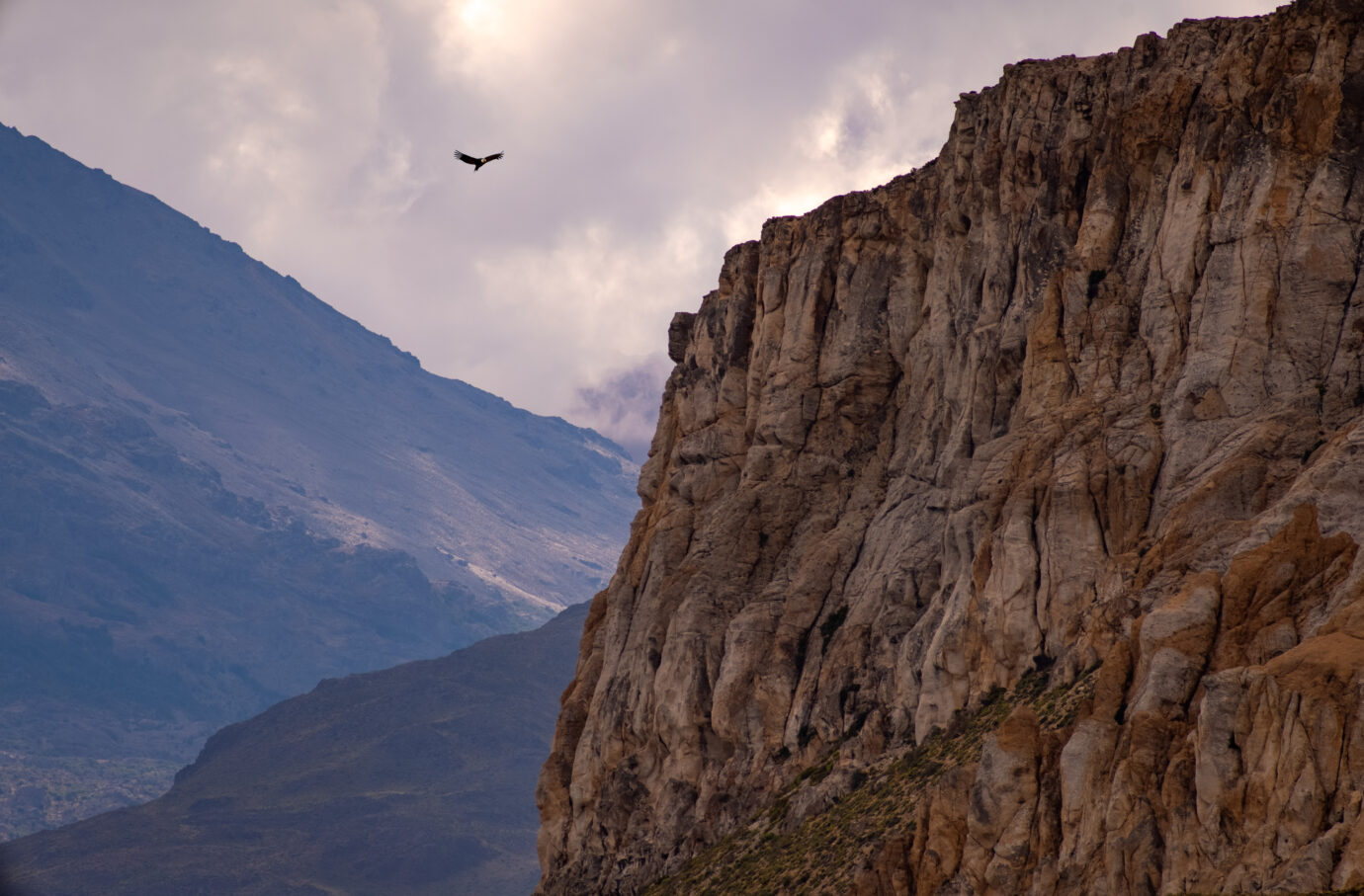
Three young Andean condors are now flying freely over the skies of Patagonia, following their release as part of Project Manku. This collaborative initiative is led by Fundación Rewilding Chile (FRC), Filantropía Cortes Solari (FCS), and Aves Chile (UNORCH) through its Raptor Rehabilitation Center. The project is also supported by the National Zoo of the Metropolitan Park, the Agricultural and Livestock Service (SAG), the National Forestry Corporation (CONAF), Bioamérica Consultores, and LATAM.
This joint effort enabled the recovery and transfer of the three condors from the Raptor Rehabilitation Center (CRAR) in the Metropolitan Region to their new home in Patagonia National Park. Last October, with the support of LATAM’s Solidarity Flight Program, the birds arrived at the park: “Carmen,” a female born in captivity in 2023; “Auquinco,” a male rescued in the Lago Ranco area bearing the same name; and “Farellón,” a male rescued in the mountain range of the Metropolitan Region. The birds remained in acclimatization for three months before being released into their natural environment.
The emotional release was witnessed by authorities and members of local communities from Chile Chico, Cochrane, Villa Cerro Castillo, and Puerto Ingeniero Ibáñez, who also had the opportunity to attend educational talks about the species.
Eduardo Pavez, Director of Project Manku, explained: “Carrying out releases in Patagonia and central Chile presents contrasting challenges and opportunities for both the project team and the condors. They face very different conditions in terms of topography, weather, food availability, and threats— all of which are human-related. For example, central Chile is a densely populated area, while Patagonia is largely ‘wild land,’ and this makes a significant difference for condors and wildlife in general.”
Cristián Saucedo, Director of the Wildlife Program at Fundación Rewilding Chile, added: “Condors play a key role in nature. They are the scavengers of the Andes, of the valleys and mountains we see today in Patagonia National Park, and they invite us to reflect on our relationship with natural ecosystems. What we experienced today would not be possible without the willingness and collaborative work of individuals and institutions committed to becoming agents of change through concrete actions.”
“Condors play a key role in nature. They are the scavengers of the Andes, of the valleys and mountains we see today in Patagonia National Park, and they invite us to reflect on our relationship with natural ecosystems. What we experienced today would not be possible without the willingness and collaborative work of individuals and institutions committed to becoming agents of change through concrete actions.”
Francisca Cortés Solari, Executive President of Filantropía Cortés Solari, emphasized: “The conservation of the Andean condor requires scientific evidence. Since 2019, as part of Project Manku, we have developed a systematic satellite monitoring program to study flight patterns and land use. This allows us to understand how condors move, what threats they face, and where critical risks are concentrated. This long-term scientific monitoring is essential for making sound conservation decisions based on data rather than assumptions. Only with solid evidence can we design policies, protection measures, and territorial strategies that truly contribute to the effective conservation of this emblematic species for Chile and the region.”
Each of the three released condors carries satellite and radio transmitters on their wings, allowing researchers to monitor their gradual adaptation to the natural environment while also collecting valuable ecological data on the species.
About the Program
The first condor release under this collaborative initiative took place in 2014. Since then, and including the three released this year, 24 Andean condors have taken to the skies thanks to Project Manku. Twenty of these individuals have been reintroduced into the wild with satellite transmitters, enabling monitoring that has confirmed that nearly all have successfully integrated into local condor populations, covering vast areas across Chilean and Argentine territory.


