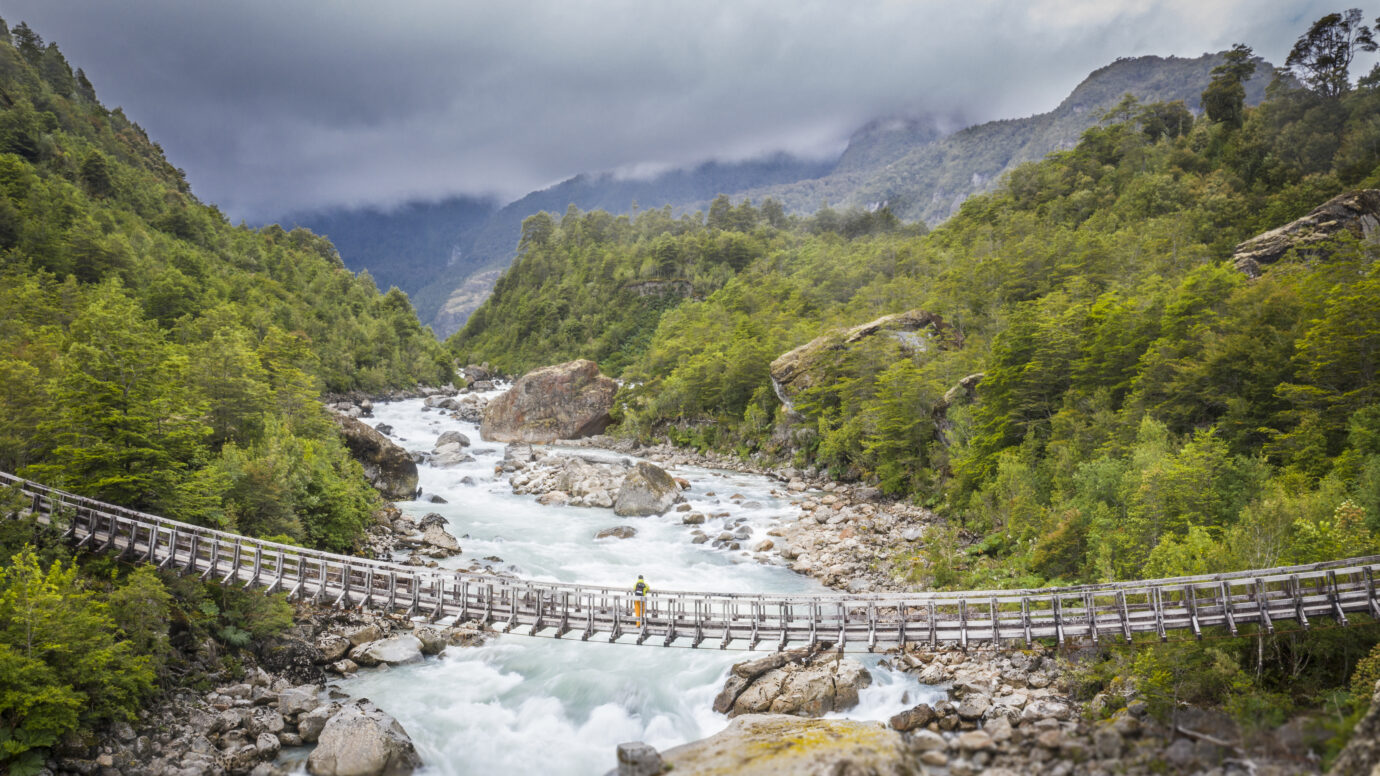
Rio Ventisquero Parque Nacional Queulat | Photo: Dietmar Denger para Sernatur
A new report developed by Rewilding Chile and the consulting firm McKinsey highlights the economic contribution of the national parks along the Route of Parks of Patagonia, projecting that by 2030, every dollar of public investment will generate USD 8.6 in income for local communities.
Rio Ventisquero Parque Nacional Queulat | Photo: Dietmar Denger para Sernatur
A study titled “Investment Impact in the Route of Parks” shows that nature conservation — through visits to protected areas — is a major driver of regional socioeconomic development. According to the report, for every dollar the Chilean state invested in the Route of Parks’ national parks in 2024, USD 6 flowed directly into local communities.
“This data matters enormously, because it confirms that national parks are an investment for the country, not an expense,” says Carolina Morgado, executive director of Rewilding Chile. She adds that beyond their ecological value and scenic beauty, the Route of Parks represents “a real opportunity for economic development across the Patagonia macro-region.”
The report also projects that for every dollar of public investment channeled into protected areas across the Los Lagos, Aysén, and Magallanes regions, the return to local communities will climb to USD 8.6.
Jaime Szigethi, partner and managing director of McKinsey & Company Chile, notes that the study “provides key evidence for better investment, infrastructure, and management decisions in protected areas,” and demonstrates that biodiversity conservation carries not just environmental value but economic value too — fueling nature-tourism activity and becoming a genuine engine of development for these territories.
The analysis combines data on visitor numbers, length of stay, and average daily spending by domestic and international tourists to the Route of Parks with the budget allocated to Chile’s National System of Protected Wild Areas (SNASPE) between 2015 and 2024. It draws on official figures from Sernatur (Chile’s National Tourism Service), the Central Bank, and the National Budget Law, along with a survey designed specifically for the study.
"This data matters enormously, because it confirms that national parks are an investment for the country, not an expense. The Route of Parks represents "a real opportunity for economic development across the Patagonia macro-region”.
Chile’s Deputy Secretary of Tourism, María Paz Lagos, called national parks “one of Chile’s great strategic assets.” She said the study clearly shows that investing in conservation, infrastructure, and quality tourism services generates direct economic returns for local communities, adding that tourism is a highly effective tool for both conservation and community development. The government’s goal, she said, is for protected areas to become engines of regional growth, employment, and investment — while always safeguarding their natural and cultural value.
According to Sernatur figures, the parks along the Route drew a record 560,000 visitors in 2024 — a 15.3% increase over pre-pandemic levels. Domestic and international tourists made up similar shares of that total (53% and 47%, respectively), but foreign visitors accounted for 72% of the USD 155 million in total revenue generated.
The gap comes down to length of stay and spending: international visitors stay longer and spend more, averaging about CLP $93,159 per day compared to roughly CLP $39,133 per day for domestic visitors. Torres del Paine National Park currently leads this economic engine, generating close to 90% of the Route’s total revenue thanks to its strong international draw.
Sernatur’s national director, Cristóbal Benítez, points to the pull of Chile’s landscapes for international travelers: recent Data Turismo figures show that 59.1% of visitors arriving in Chile by air cite nature as one of the main reasons they chose the country as a vacation destination.
To scale this potential and position Chile as a world leader in conservation, the study offers several recommendations: making conservation a central pillar of the country’s brand, diversifying funding sources for protected areas, and strengthening the role of the Biodiversity and Protected Areas System (SBAP). It also stresses the need for solid, centralized data — since information is currently scattered across different institutions, making it harder to access and analyze.